Regulators of the angelic orders beneath them, transmitting divine governance without subjection to earthly disorder (Ephesians 1:21; Colossians 1:16).
Dominions
The Dominions, also called Dominations or Lordships, are the fourth-ranked order of angels in Christian angelology and the first choir of the second triad, marking the transition from the first triad's direct contemplation of God to a role concerned with governing the cosmos itself. Where the Seraphim, Cherubim, and Thrones exist primarily in relation to the divine presence, the Dominions face outward: their traditional function is to regulate the activity of the angelic orders below them, acting as administrators who translate divine will into cosmic order rather than executing it directly.
Etymology
The English name descends from the Latin dominatio (plural dominationes, "lordship" or "rule"), itself a translation of the Greek kyriotēs (plural kyriotētes), the term Paul the Apostle uses in Ephesians 1:21 and Colossians 1:16 (Dominion (angel) — Wikipedia).
History
Like the Thrones, the Dominions rest on a thin and largely undescribed New Testament basis: Paul lists them among the ranks of spiritual authority subject to Christ in both Ephesians 1:21 and Colossians 1:16 (Ephesians 1 — Wikipedia), without describing their appearance, number, or specific activity. The apocryphal Second Book of Enoch places dominions among the ranks of angels Enoch encounters in the seventh heaven, alongside other named orders, giving the earliest narrative rather than merely listed appearance of the class.
Pseudo-Dionysius the Areopagite gave the Dominions their lasting position in The Celestial Hierarchy (5th–6th century CE) (De Coelesti Hierarchia — CCEL; Dionysius the Pseudo-Areopagite — New Advent), ranking them fourth overall and first in the second triad, alongside the Virtues and Powers. In this scheme the second triad as a whole governs the cosmos, standing between the first triad's contemplative closeness to God and the third triad's direct engagement with human affairs. Thomas Aquinas, in the Summa Theologica (1265–1274) (Summa Theologica I, Q.108 — New Advent), elaborated on this by describing the Dominions as angels who are not themselves sent on missions to the world but who direct and authorize the orders below them that are, ensuring that the execution of divine commands proceeds in proper order down through the hierarchy — a supervisory rather than executive role.
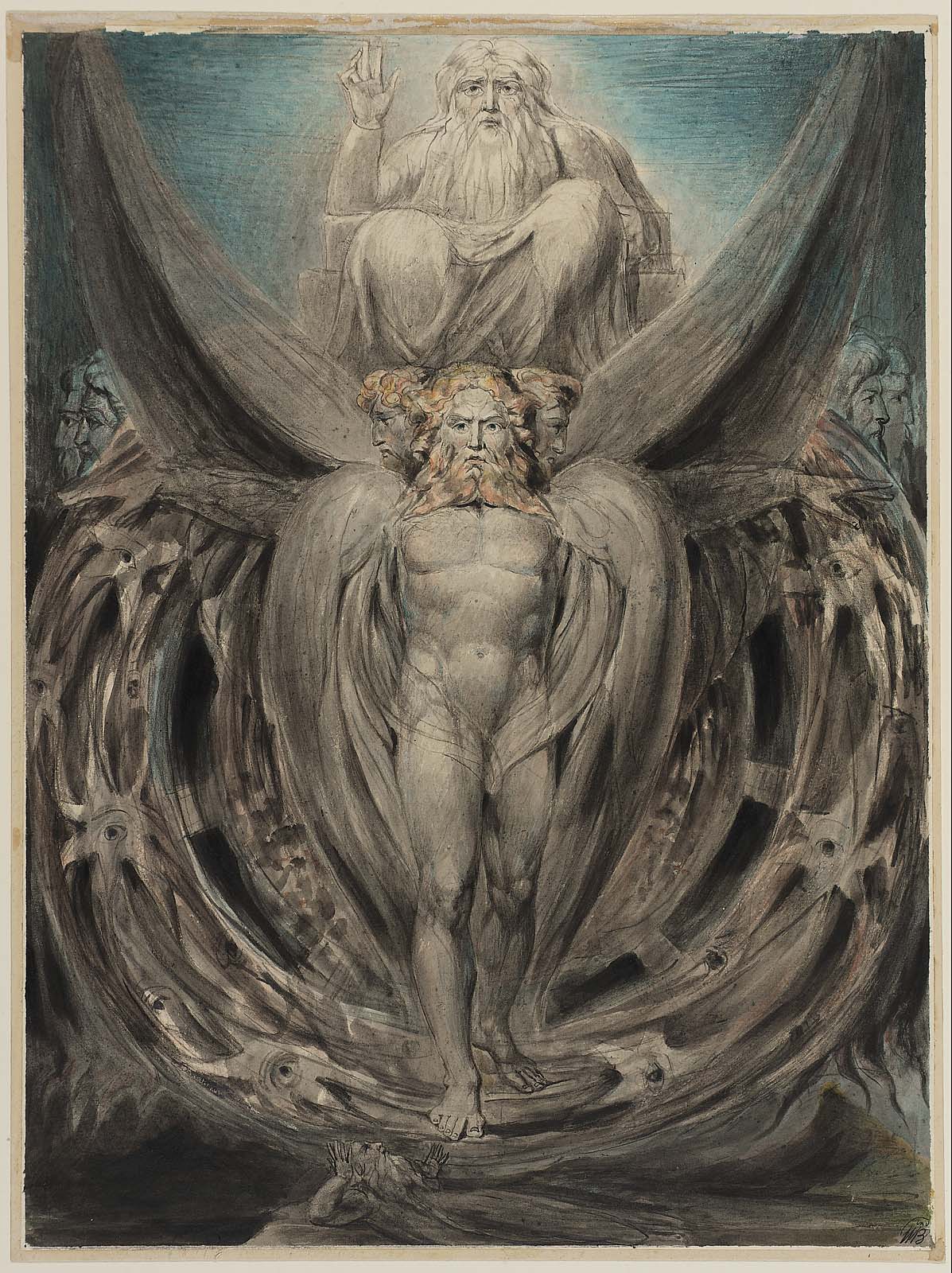
fig-dominions-blake: William Blake, Ezekiel's Vision, ca. 1803–1805 (Museum of Fine Arts, Boston) — via Wikimedia Commons (public domain).
Iconography and the symbols of rule
Because scripture gives the Dominions no described form, their visual tradition in medieval and Byzantine art developed independently, drawing on the imagery of earthly kingship rather than any biblical vision. Painters and manuscript illuminators most often show them crowned and holding a scepter or an orb — sometimes a globe topped with a cross, in the same tradition as the regalia of medieval monarchs — with a sword occasionally substituted or added as a further mark of authority. Unlike the wheels of the Thrones or the four faces of the Cherubim, these attributes carry no scriptural warrant at all; they are a visual language borrowed wholesale from royal portraiture to represent a rank whose sole textual description is a single word in two Pauline epistles.
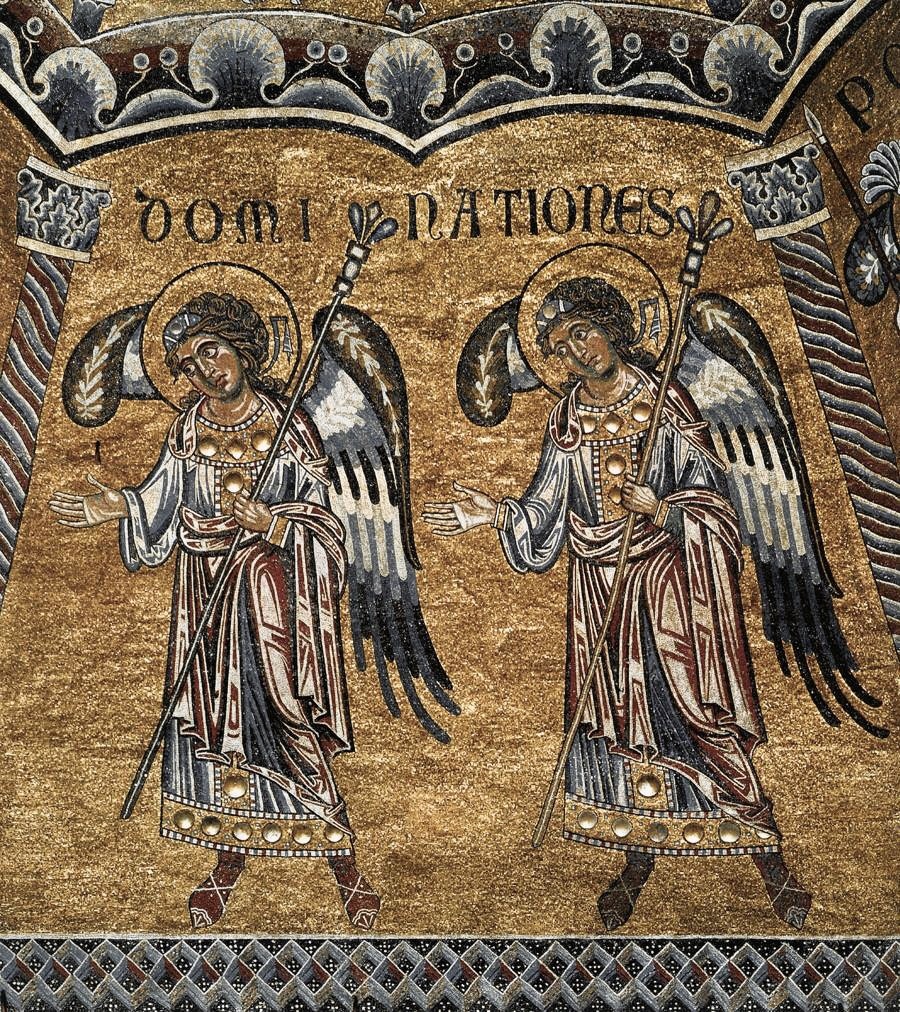
fig-dominions-baptistery: Angelic hierarchy mosaic, Florence Baptistery (attr. Andrea Tafi, 13th c.) — photo via [Wikimedia Commons](<https://commons.wikimedia.org/wiki/File:Andrea_tafi_e_apollonio_(attr.),_gerarchie_angeliche_del_battistero_di_firenze,_dal_1225,_dominazioni.jpg>) (CC BY-SA 4.0).
Related characters
| Entity | Relationship |
|---|---|
| Thrones | Third-ranked choir, closing the first triad that precedes the Dominions |
| Virtues | Second-ranked choir of the second triad, working alongside the Dominions to govern the cosmos |
| Powers | Third-ranked choir of the second triad, traditionally tasked with maintaining cosmic order under the Dominions' direction |
Sources
- Dominion (angel) — Wikipedia
- Ephesians 1 — Wikipedia
- Second Book of Enoch — Wikipedia
- De Coelesti Hierarchia — CCEL
- Dionysius the Pseudo-Areopagite — New Advent
- Summa Theologica I, Q.108 — New Advent
- Ephesians 1:21 — BibleHub
- Colossians 1:16 — BibleHub
- Christian Angelic Hierarchy — Religion Wiki
- Chapter Four: The Celestial Hierarchy — My Catholic Life!
Sources: Eph 1:21 · Col 1:16