Bearers of divine justice and the seat of God's judgment, contemplating the divine decrees in perfect humility (Colossians 1:16; De Coelesti Hierarchia, ch. 7).
Thrones
The Thrones are the third-ranked order of angels in Christian angelology, completing the first triad alongside the Seraphim and Cherubim. Where the Seraphim burn with love and the Cherubim hold fullness of knowledge, the Thrones are associated with stability, justice, and the literal bearing of God's presence — their name describing what they are said to be, rather than merely what they do. Unlike the Seraphim and Cherubim, the Thrones rest on a comparatively thin and disputed scriptural basis, stitched together from two biblical traditions that were never explicitly connected in the text itself.
Etymology
The name comes directly from the Ancient Greek thronos ("seat" or "throne"), by way of the Latin thronus; in Hebrew angelology the order is often equated instead with the Ophanim, literally "wheels" (Throne (angel) — Wikipedia; Ophanim — Wikipedia).
History
The order's biblical foundation rests on two separate passages that later tradition wove together. The first is the apostle Paul's letter to the Colossians, which lists "thrones" among the things created through Christ, alongside dominions, rulers, and authorities (Colossians 1:16) — a brief, unadorned mention that does not describe the thrones' appearance or function at all. The second is the prophet Ezekiel's vision of wheels beside the four living creatures, "so high that they were dreadful," their rims "full of eyes all around" (Ezekiel 1:15–18; Ezekiel, Chapter 1 — USCCB), which he identifies elsewhere as moving in tandem with the cherubim bearing God's glory (Ezekiel 10:9–17; Ezekiel, Chapter 10 — USCCB). These wheels are called ophanim in Hebrew, a word meaning simply "wheels," and the text never calls them "thrones" or explicitly identifies them as a class of angel distinct from the cherubim they accompany.
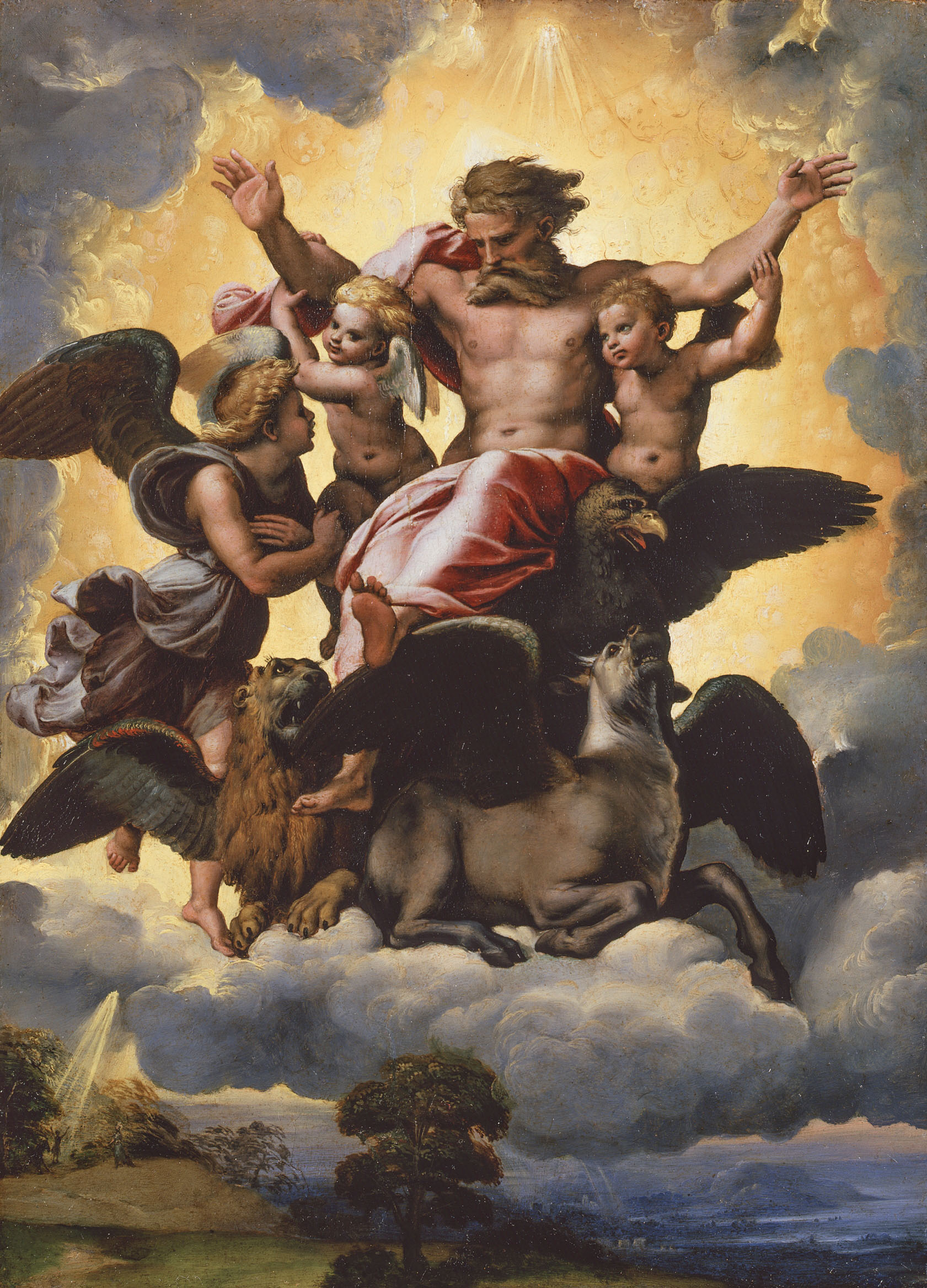
fig-thrones-ezekiel: Raphael, Ezekiel's Vision, 1518 (Galleria Palatina) — via Wikimedia Commons (public domain).
The identification of Paul's "thrones" with Ezekiel's wheel-vision was a later theological synthesis rather than a claim made directly by either author. Pseudo-Dionysius the Areopagite formalized this synthesis in The Celestial Hierarchy (5th–6th century CE) (De Coelesti Hierarchia — CCEL; Dionysius the Pseudo-Areopagite — New Advent), placing the Thrones as the third and final order of the highest triad. He described them as "exempt from and unattained by any base and earthly thing," dwelling in "fullest power, immovably and perfectly established in the Most High," and drew their meaning from the Greek image of a throne or seat: beings so given over to receiving God's presence that they become, in effect, seats on which that presence rests. Thomas Aquinas later incorporated this ranking into the Summa Theologica (1265–1274) (Summa Theologica I, Q.108 — New Advent), where the Thrones' place in the first triad reflects their function of manifesting divine judgment and sovereign order directly, without mediation, rather than transmitting it downward as the lower choirs do.
Jewish angelology developed the wheel tradition somewhat differently: several rabbinic and kabbalistic hierarchies list the Ophanim as their own distinct rank, separate from any "thrones," and rank them at varying positions relative to the cherubim and other classes across different texts — a reminder that the tidy ninefold Christian scheme was one systematization among several competing ones, not the only way the same source material was organized.
fig-thrones-saturn: Saturn in natural color (Cassini, 2008) — NASA/JPL/Space Science Institute, via Wikimedia Commons (public domain).
An angel built from a metaphor
Compared to the Seraphim's single vivid appearance in Isaiah or the Cherubim's repeated narrative role guarding Eden and the Ark, the Thrones have almost no independent scriptural identity of their own — no vision, no name, no described appearance. Everything commonly said about them is an inference: their appearance as "wheels full of eyes" is borrowed wholesale from Ezekiel's ophanim, who are never called thrones in the text, while their name comes from a one-word mention in Colossians that carries no description at all. Some biblical commentators have gone further, questioning whether Colossians 1:16 refers to angels as individual beings in the first place, rather than simply listing categories of cosmic authority — human or otherwise — that Paul says are subject to Christ. The Thrones are, in this sense, less a described entity than a theological placeholder: a rank the tradition needed to complete its structure of divine attributes, filled in with the most fitting image scripture had to offer.
Related characters
| Entity | Relationship |
|---|---|
| Seraphim | First-ranked choir of the first triad; associated with love rather than justice or stability |
| Cherubim | Second-ranked choir of the first triad; in Ezekiel's vision, the cherubim bear the wheels (ophanim) associated with the Thrones (Ezekiel 10:9–17) |
| Ophanim | The "wheels" of Ezekiel's vision, commonly identified with the Thrones in Christian tradition though kept distinct in most Jewish sources (Ophanim — Wikipedia) |
| Ezekiel | Prophet whose wheel-vision supplies the Thrones' traditional appearance (Ezekiel 1:15–18) |
Sources
- Throne (angel) — Wikipedia
- Throne (angel) — Grokipedia
- Ophanim — Wikipedia
- De Coelesti Hierarchia — CCEL
- Dionysius the Pseudo-Areopagite — New Advent
- Summa Theologica I, Q.108 — New Advent
- Colossians 1:16 — BibleHub
- Ezekiel 1:15–18 — Sefaria
- Ezekiel 10:9–17 — Sefaria
- Ezekiel, Chapter 1 — USCCB
- Ezekiel, Chapter 10 — USCCB
Sources: Col 1:16 · DCH VII