Chief heralds entrusted with the weightiest revelations, bridging heaven's counsel and human history.
Archangels
Archangels are the eighth-ranked order of angels in Christian angelology, the second choir of the third and lowest triad, and by far the best-known and most individually named rank in the entire ninefold hierarchy. Where the choirs above them are defined mainly by abstract function — knowledge, love, governance, might — the Archangels are known chiefly as individuals: Michael, Gabriel, and Raphael appear by name across Judaism, Christianity, and Islam, carrying out the most consequential divine messages and interventions in scripture. The name itself creates a lasting tension the tradition never fully resolved: "archangel" literally means "chief of the angels," yet the rank sits second from the bottom of the classical nine.
Etymology
The word comes from the Greek archangelos, a compound of archē ("first," "chief," or "ruler") and angelos ("messenger") (G743 archangelos — Blue Letter Bible), and appears not to occur in Greek literature before the first century CE, making it a distinctly Jewish and early Christian coinage rather than a term inherited from earlier usage (Seven Archangels — Wikipedia).
History
The word "archangel" appears only twice in the entire New Testament: once unnamed, in Paul's description of the Lord's return "with the voice of an archangel" (1 Thessalonians 4:16), and once naming Michael directly, in Jude's account of a dispute over the body of Moses (Jude 1:9). No archangel is named in the canonical Hebrew Bible at all; the earliest references to a distinct class of "chief" angels appear in intertestamental Jewish literature of the last centuries BCE. The archangel Gabriel is named separately in the New Testament — announcing the births of John the Baptist and Jesus (Luke 1:11–38) — but is never explicitly called an "archangel" in the biblical text itself; that title is applied to him only by later tradition. Raphael is named in the deuterocanonical Book of Tobit, where he heals Tobit's blindness, protects his son Tobias, and identifies himself as "one of the seven angels who stand ready and enter before the glory of the Lord" (Tobit 12:15) — a detail that became the scriptural seed for the widespread tradition of seven archangels.
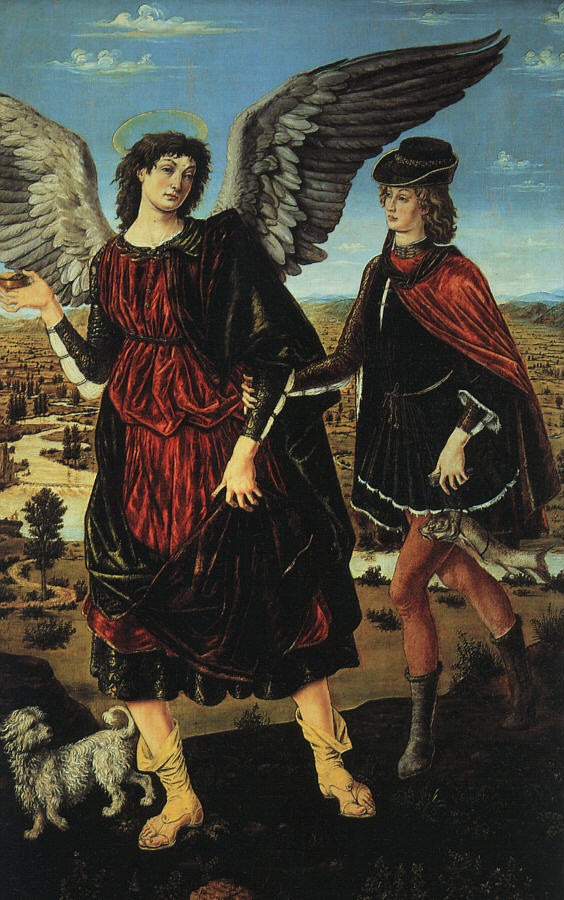
fig-archangels-tobias: Antonio del Pollaiuolo, Tobias and the Angel, ca. 1460s — via Wikimedia Commons (public domain).
That tradition of seven takes different shapes across traditions that all trace back to the same handful of core names. The Book of Enoch, an intertestamental Jewish text quoted directly in the New Testament (Jude 1:14–15) though excluded from most biblical canons, lists seven holy angels including Michael, Gabriel, Raphael, and Uriel, with the remaining three names varying by manuscript. Pseudo-Dionysius the Areopagite, writing in the 5th–6th century CE (Dionysius the Pseudo-Areopagite — New Advent), formally placed the Archangels eighth in his ninefold hierarchy (De Coelesti Hierarchia — CCEL), second only to the lowest choir of Angels — but named individually gave them a level of prominence in devotion and iconography that most other choirs never received. The Roman Catholic Church names only three archangels in its scriptural canon (Michael, Gabriel, Raphael), while the Eastern Orthodox and Ethiopian Orthodox traditions venerate a full company of seven or eight, with names such as Uriel, Selaphiel, Jegudiel, Barachiel, and Jerahmeel appearing depending on the specific liturgical tradition. Islam preserves a close but independent parallel: the archangels Jibril (Gabriel), Mika'il (Michael), Israfil, and Azrael carry out comparable functions — revelation, sustenance, the trumpet of resurrection, and the taking of souls — within a hierarchy that developed separately from the Christian one but clearly draws on shared Abrahamic roots.
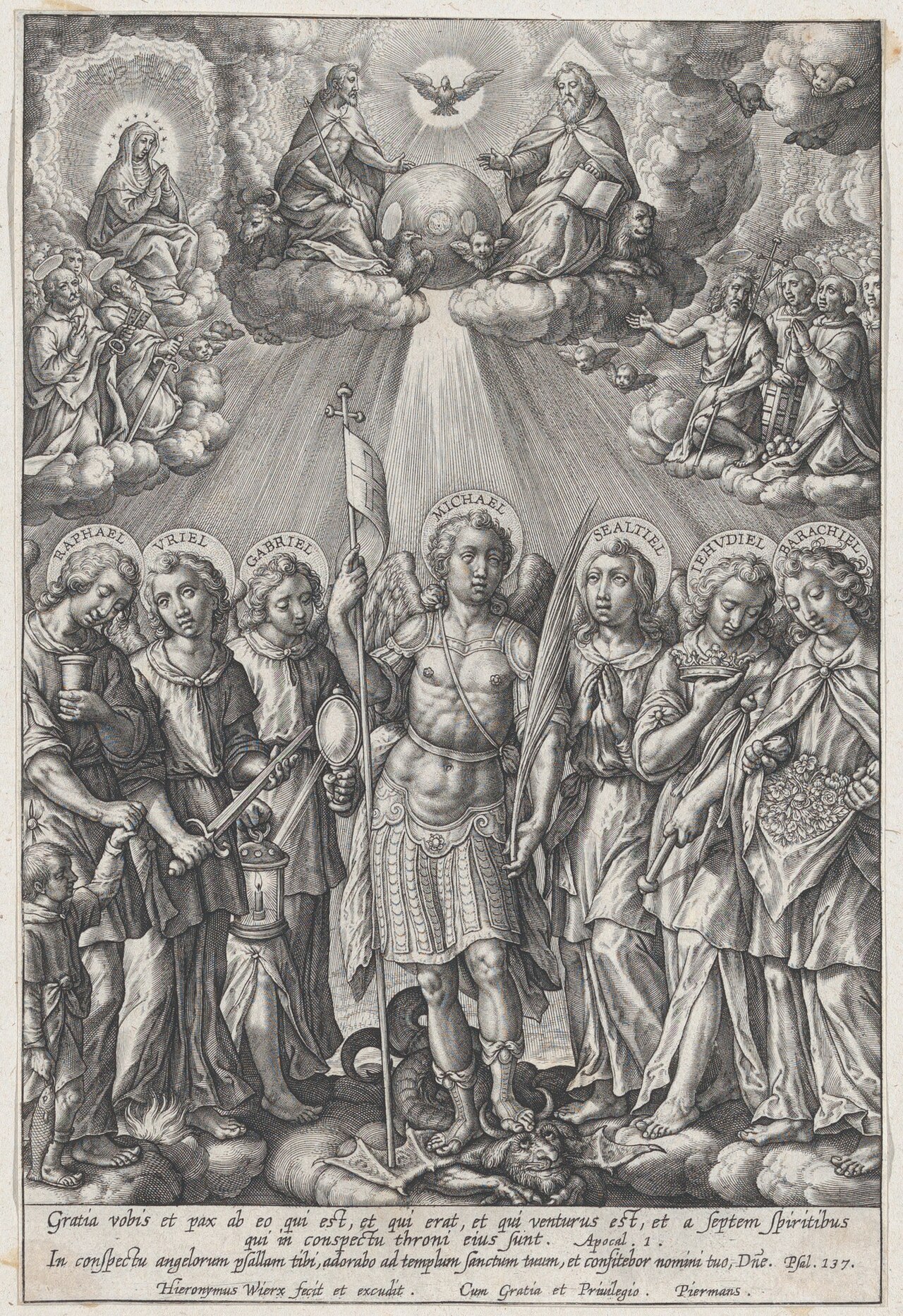
fig-archangels-seven: Hieronymus Wierix, St. Michael and Archangels (The Seven Archangels) — Metropolitan Museum of Art (open access, CC0), via [Wikimedia Commons](<https://commons.wikimedia.org/wiki/File:St._Michael_and_Archangels_(The_Seven_Archangels)_MET_DP876554.jpg>).
A rank that outgrew its own name
No other choir in the Dionysian system carries as sharp a contradiction between its name and its assigned place as the Archangels do. "Archangel" literally means "ruler" or "first" among angels, yet Pseudo-Dionysius ranks the order eighth of nine — below the Principalities, and above only the ordinary Angels who interact directly with individual humans. Some theologians and Eastern Christian traditions have resisted the rank-based reading entirely, arguing that "archangel" does not designate a position within a graded hierarchy at all, but simply describes an angel of exceptional might regardless of formal rank — which is consistent with how Michael is actually described in scripture. Far from acting like a mid-tier functionary, Michael is called "the great prince" who stands guard over Israel (Daniel 12:1), commands the heavenly armies against the dragon (Revelation 12:7), and disputes directly with the devil (Jude 1:9) — the resume of a supreme commander, not a second-to-lowest-ranking angel. No systematic hierarchy among the archangels themselves has ever been formally settled either, even within traditions that name several of them; Michael is consistently treated as foremost among them in practice, whatever his official rank on paper.
Related characters
| Entity | Relationship |
|---|---|
| Principalities | First-ranked choir of the third triad, preceding the Archangels |
| Angels | Third and lowest choir of the third triad, following the Archangels |
| Archangel Michael | The only archangel named in the New Testament (Jude 1:9); commander of the heavenly host (Revelation 12:7) |
| Archangel Gabriel | Messenger who announces the births of John the Baptist and Jesus (Luke 1:11–38) |
| Archangel Raphael | Healer named in the Book of Tobit; identifies himself as one of the seven who stand before God (Tobit 12:15) |
| Satan / Lucifer | Opposed directly by Michael in both Jude 1:9 and Revelation 12:7 |
Sources
- Seven Archangels — Ascension Glossary
- The Four Archangels in the Bible — Bible With Life
- G743 archangelos — Blue Letter Bible
- Seven Archangels — Wikipedia
- Book of Enoch — Wikipedia
- De Coelesti Hierarchia — CCEL
- Dionysius the Pseudo-Areopagite — New Advent
- 1 Thessalonians 4:16 — BibleHub
- Jude 1:9 — BibleHub
- Jude 1:14–15 — BibleHub
- Luke 1:11–38 — BibleHub
- Revelation 12:7 — BibleHub
- Daniel 12:1 — Sefaria
- Tobit 12 — USCCB
Sources: Dan 10:13 · Jude 1:9 · Tob 12:15 · DCH IX
Note: “Archangel” here is the eighth Dionysian choir, not a claim about individual rank — folk usage (Michael, Gabriel, Raphael) names persons, not this choir’s station.