Above the Nine Choirs, the uncaused source from which every choir radiates. Not a rank within the hierarchy but the point all hierarchies converge on across Jewish, Christian, Islamic, Gnostic, and Kabbalistic tradition.
God
God is the singular, supreme, uncreated being at the center of Christian theology — understood as the eternal creator, sustainer, and ultimate authority over the universe, worshipped as one being existing in three persons: the Father, the Son (Jesus Christ), and the Holy Spirit. Within Christianity, God is generally described as all-knowing, all-powerful, and perfectly good, and as the source from which all other reality, including the angels, derives. Whether such a being exists at all — and, if so, whether it can be adequately described by any of these attributes — remains disputed among philosophers, theologians, and ordinary believers and non-believers alike, with arguments on both sides that neither camp has managed to fully settle.
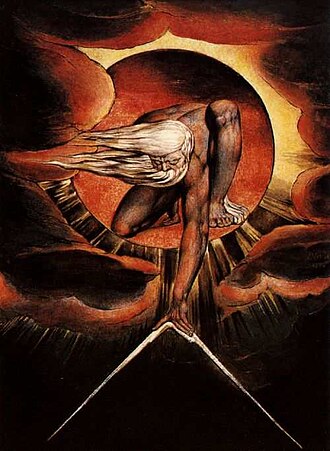
fig-god-ancient-days: William Blake, The Ancient of Days, 1794; via Wikimedia Commons (public domain).
Etymology
The English word "God" descends from the Old English god, itself from the reconstructed Proto-Germanic \*gudą, whose deeper origin is genuinely disputed among linguists — it may derive from a root meaning "to invoke" or one meaning "to pour" (as in a libation), and the term was originally grammatically neuter before shifting to masculine usage after Germanic Christianization. This is distinct from the Hebrew name most central to the Christian and Jewish scriptures, the Tetragrammaton YHWH (traditionally rendered "Yahweh" or "Jehovah"), revealed to Moses at the burning bush (God (word) — Wikipedia).

fig-god-allah: Calligraphy of the name Allah; via Wikimedia Commons (public domain).
History
Israelite origins and the Hebrew Bible
The Christian conception of God begins with the God of the Hebrew Bible, worshipped by the ancient Israelites under the name YHWH (the Tetragrammaton), a name held so sacred that by the Second Temple period Jews had largely stopped pronouncing it, substituting "Adonai" ("my Lord") or "Elohim" ("God") in speech and prayer instead (Yahweh — Britannica). According to the Book of Exodus, God revealed this name to Moses at the burning bush, declaring "I AM WHO I AM" (Exodus 3:14) — a statement traditionally read as an assertion of self-existence and eternal being. Historians of religion note that many biblical texts assume Yahweh was also known to and worshipped by other peoples of Canaan, and that Israelite monotheism (the belief in only one God, as opposed to only worshipping one God among many that were believed to exist) developed gradually over centuries rather than appearing fully formed (Yahweh — World History Encyclopedia). Across the Hebrew Bible, God is depicted as creator of heaven and earth (Genesis 1–2), covenant-maker with Abraham, Isaac, and Jacob (Genesis 12–35), lawgiver at Sinai (Exodus 19–20), and the God of Israel's national history.
The New Testament and the Christian reinterpretation
The New Testament writers, all working within Second Temple Jewish monotheism, identified the God of Israel as the father of Jesus of Nazareth and, through reflection on Jesus's life, death, and resurrection, and on the presence of the Holy Spirit within the early church, began to speak of God in a threefold way. Early Christian writers such as Justin Martyr (100–c. 160 CE) argued that God had appeared throughout the Hebrew scriptures in a form later identified with the pre-existent Christ, an interpretive move meant to preserve the oneness of God while accounting for the divinity ascribed to Jesus. This threefold pattern — Father, Son, and Holy Spirit — became the seed of what would later be formalized as the doctrine of the Trinity.
Formalization at Nicaea and beyond
The word "Trinity" itself does not appear anywhere in the Bible; it is a later theological term coined to describe a pattern of divine self-revelation that the early church came to believe it had received. The doctrine was given its classic formulation at the First Council of Nicaea in 325 CE, which affirmed that the Son is "of the same substance" (homoousios) as the Father, and was further developed at the First Council of Constantinople in 381 CE (Trinity — Britannica; Trinity — World History Encyclopedia). Later controversies — including the _Filioque_ dispute over whether the Holy Spirit proceeds from the Father alone or from the Father and the Son — would go on to divide Eastern and Western Christianity.
The Trinity
Trinitarian doctrine holds that there is one God existing eternally as three distinct persons — the Father, the Son, and the Holy Spirit — who are co-equal, co-eternal, and of one substance, rather than three separate gods or three sequential "modes" of a single God (a rejected position historically labeled modalism). The Athanasian Creed summarizes the paradox at the doctrine's heart: "the Father is God, the Son is God, and the Holy Spirit is God, and yet there are not three Gods but one God" (Holy Trinity — Britannica). Theologians have generally treated the Trinity as a revealed mystery rather than a truth demonstrable by unaided reason — something the church came to confess on the basis of its experience of Christ and the Spirit, not something deduced from philosophical first principles. Not all Christian traditions accept it: some groups historically labeled unitarian or non-trinitarian reject the doctrine while still identifying as Christian, and it remains one of the most distinctive and, outside Christianity, most contested claims about God's nature.
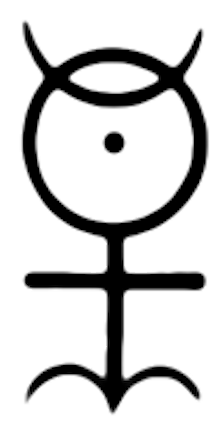
fig-god-monas: John Dee, Monas Hieroglyphica, 1564; via Wikimedia Commons (public domain).
Attributes of God's nature
Classical Christian theology ascribes a cluster of "perfections" to God, most commonly:
- Omniscience — complete or maximal knowledge of all truths, often derived from biblical language describing God's vast wisdom (e.g. Job 12:13) and from the philosophical tradition of "perfect being theology," which reasons that a maximally great being must possess maximal knowledge (Omniscience — Stanford Encyclopedia of Philosophy).
- Omnipotence — unlimited power, generally understood by theologians as the power to do anything that is logically possible, rather than a power to do the strictly self-contradictory.
- Omnibenevolence — perfect moral goodness.
- Omnipresence and eternity — being present everywhere at once and existing outside or throughout all time.
These attributes are not merely devotional language; they have generated centuries of technical philosophical debate. Philosophers have asked, for instance, whether an omniscient God's foreknowledge of future human choices is compatible with those choices being genuinely free, and whether omniscience entails changelessness or is compatible with a God who experiences time.
The problem of evil
One of the oldest and most persistent challenges to this conception of God is the problem of evil: if God is all-powerful, all-knowing, and perfectly good, why does the world contain suffering and wrongdoing that, it seems, such a God could and would prevent? Philosophers distinguish logical versions of the argument (which claim God's existence is strictly incompatible with any evil at all) from evidential versions (which claim only that the amount and kinds of evil actually observed make God's existence improbable, without ruling it out entirely). In response, theologians and philosophers have proposed various theodicies — attempted explanations of why God might permit evil — including free-will defenses (evil results from creatures' free choices, which are themselves a good worth the risk) and "soul-making" theodicies (a world with real hardship is necessary for moral and spiritual growth). None of these responses commands full consensus, and the problem is generally regarded as the strongest single argument raised against belief in a God with all three of these attributes, which is part of why serious, informed people arrive at very different conclusions about whether such a God exists at all.
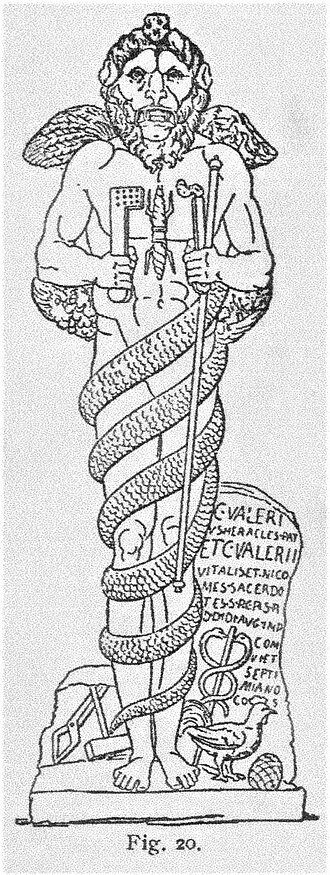
fig-god-yaldabaoth: Lion-headed god, Mithraeum of Fagan, Ostia; via Wikimedia Commons (public domain).
Related characters
| Entity | Relationship |
|---|---|
| Jesus Christ | The Son, second person of the Trinity; understood as God incarnate (Trinity — Wikipedia) |
| Holy Spirit | Third person of the Trinity; God's active presence in the world and the church |
| Satan / Lucifer | Fallen angel and chief adversary; a created being in rebellion against God, not God's opposite or equal |
| Archangel Michael | Highest-ranking angel in most traditions; serves as God's chief messenger and warrior (Michael (archangel) — Wikipedia) |
| Moses | Israelite prophet to whom God revealed the name YHWH at the burning bush (Exodus 3:14) |
Sources
- Holy Trinity — Britannica
- Trinity — Britannica
- Yahweh — Britannica
- God (word) — Wikipedia
- Trinity — Wikipedia
- Yahweh — World History Encyclopedia
- Trinity — World History Encyclopedia
- The Problem of Evil — Stanford Encyclopedia of Philosophy
- Omniscience — Stanford Encyclopedia of Philosophy
- Exodus 3:14 — Sefaria
Sources: Ex 3:14 · Rev 1:8 · DCH IV