The lowest choir and closest to humanity, ministering spirits sent as guardians, messengers, and guides to individual souls.
Angels
Angels are the ninth and lowest-ranked order in Christian angelology, closing the third and final triad and standing nearer to humanity than any other choir. Where the higher orders are defined by contemplation of God or governance of the cosmos, this lowest choir is defined by direct, personal contact with individual people — delivering messages, offering protection, and, in the most widely held popular tradition to come out of the entire ninefold system, serving as the personal guardian angel assigned to a single human being. It is also the order from which the generic word "angel" is drawn, even though every being in all nine choirs is, in the broadest sense, an angel.
Etymology
The name comes from the Greek angelos, meaning simply "messenger," by way of the Latin angelus (Angel — Wikipedia); the Hebrew equivalent, mal'akh, carries the same core sense and is used throughout the Old Testament for any being — human or celestial — sent to deliver a message (Angelolatry — Wikipedia).
History
Angels, in the general sense of divine messengers, appear more often in scripture than any other class of celestial being, running from Genesis to Revelation: they announce the destruction of Sodom to Lot (Genesis 19), wrestle with Jacob (Genesis 32:24–30), minister to Christ after his temptation in the wilderness (Matthew 4:11), announce his birth to the shepherds (Luke 2:8–14), and comfort him in Gethsemane (Luke 22:43). Pseudo-Dionysius the Areopagite, in The Celestial Hierarchy (5th–6th century CE) (De Coelesti Hierarchia — CCEL; Dionysius the Pseudo-Areopagite — New Advent), placed "Angels" as a distinct and specific rank — the ninth and lowest — reserving the term that names the whole category for the choir that stands closest to human affairs, distinguishing it from the higher, more abstract orders such as the Principalities and Archangels above it. Thomas Aquinas, in the Summa Theologica (1265–1274) (Summa Theologica I, Q.108 — New Advent), affirmed this lowest position on the reasoning that it is fitting for the order most directly engaged with individual human beings to occupy the rank nearest to the material world it serves.
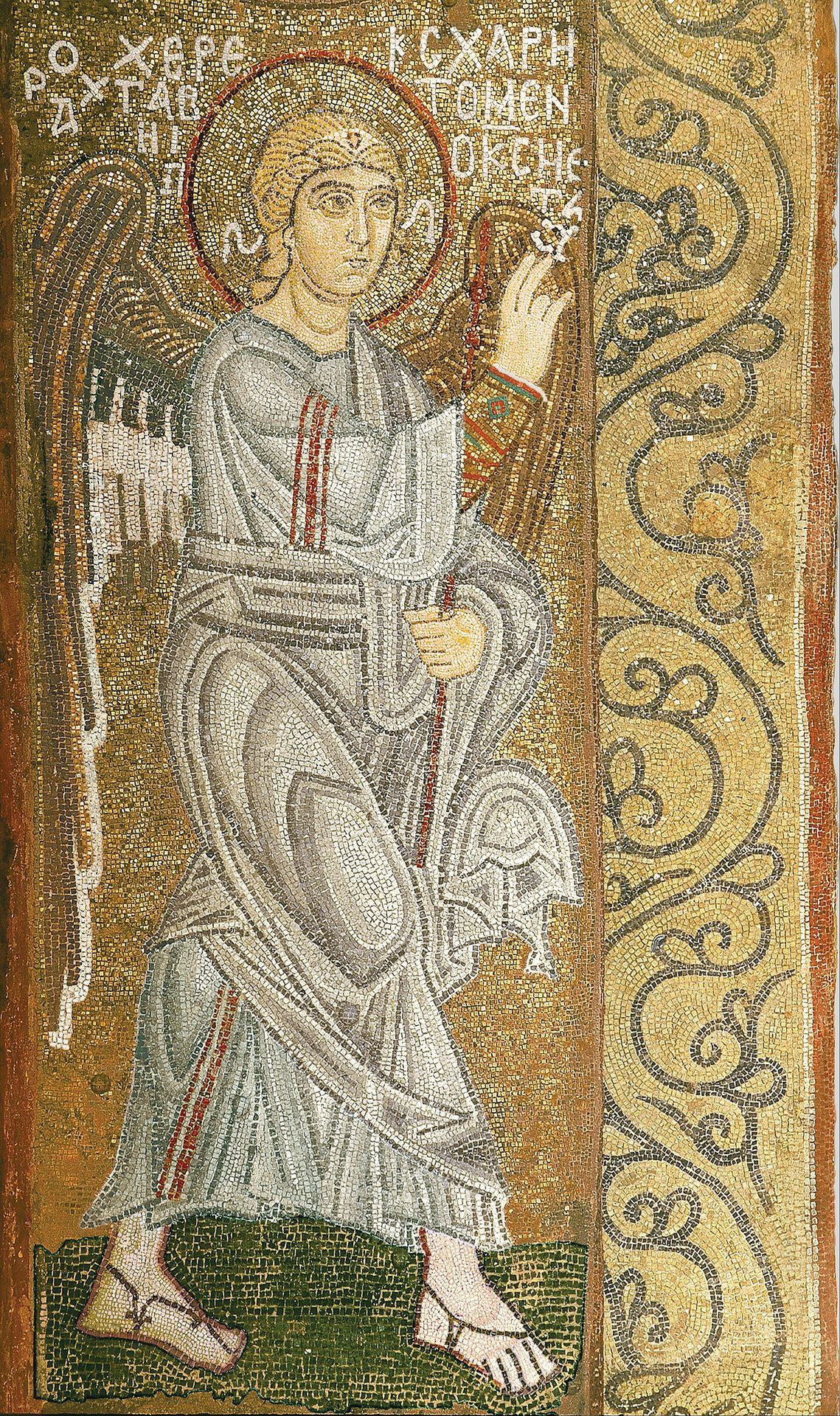
fig-angels-gabriel: The archangel Gabriel (St Sophia, Kyiv mosaic) — the same portrait used for Gabriel and on the Cherubim page; via Wikimedia Commons (public domain).
It is from this lowest choir that Christian tradition draws the doctrine of the guardian angel — the belief that each person is assigned a specific angel as protector and guide. The doctrine's most cited scriptural basis is a saying of Jesus:
> "See that you do not despise one of these little ones. For I tell you that in heaven their angels always see the face of my Father who is in heaven." (Matthew 18:10)
Supporting texts include Psalm 91:11–12 ("he will command his angels concerning you to guard you in all your ways") and the account in Acts 12:15, where the disciples, disbelieving that Peter has been freed from prison, suggest that the person at the door must be "his angel." The fourth-century theologian Basil of Caesarea affirmed the doctrine as an established consensus by his time, and Origen of Alexandria discussed it in the previous century, though the precise scope of Matthew 18:10 — whether it establishes one lifelong angel per person, or simply describes angels attending to vulnerable people in general — has been debated since antiquity and remains disputed among biblical scholars and denominations today.
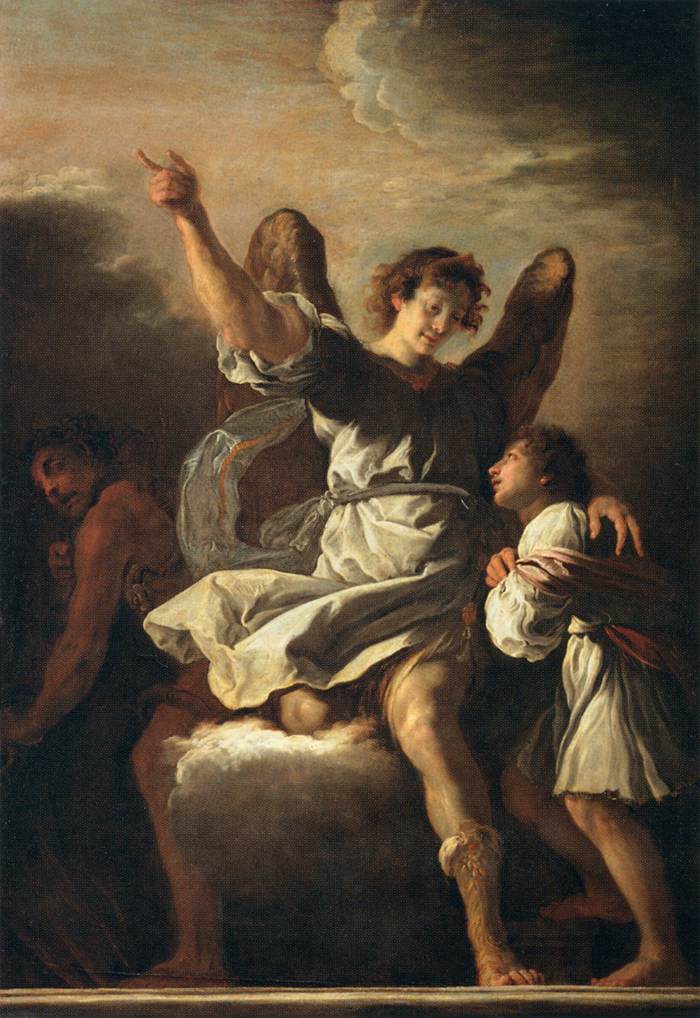
fig-angels-guardian: Domenico Fetti, The Guardian Angel Protecting a Child from the Empire of the Demon — via Wikimedia Commons (public domain).
The name that means everyone, applied to almost no one
The word "angel" presents a mirror image of the paradox found in "archangel": where "archangel" means "chief of the angels" yet names a rank second from the bottom, "angel" is the ordinary word for every being in the entire ninefold system — Seraphim, Cherubim, and all the rest are all, technically, angels — yet Pseudo-Dionysius reserves the specific term for only the lowest and least individually distinguished of the nine choirs. In practice, this means the choir called simply "Angels" has almost no individual identity of its own within the hierarchy: unlike the Archangels, no members of this lowest order are named in scripture or tradition, and unlike the Seraphim or Cherubim, no vision describes their appearance. Their entire character is defined relationally, by their nearness to a specific person or place, rather than by any trait belonging to the order itself — an appropriate closing note for a hierarchy that began, nine ranks earlier, with beings whose entire identity was defined instead by their nearness to God.
Related characters
| Entity | Relationship |
|---|---|
| Archangels | Second-ranked choir of the third triad, immediately preceding the Angels |
| Satan / Lucifer | Traditionally understood as a fallen angel, though accounts vary as to his original rank within the hierarchy |
| Jacob | Wrestled with an angel in Genesis 32, one of the Bible's most direct angel-human encounters |
Sources
- Angels — New Advent
- All Angels Were Not Created Equal — Catholicism.org
- Do Guardian Angels Exist? — Logos
- Angel — Wikipedia
- Angelolatry — Wikipedia
- Basil of Caesarea — Wikipedia
- Origen — Wikipedia
- De Coelesti Hierarchia — CCEL
- Dionysius the Pseudo-Areopagite — New Advent
- Summa Theologica I, Q.108 — New Advent
- Genesis 19 — Sefaria
- Genesis 32:24–30 — Sefaria
- Psalm 91:11–12 — Sefaria
- Matthew 4:11 — BibleHub
- Matthew 18:10 — BibleHub
- Luke 2:8–14 — BibleHub
- Luke 22:43 — BibleHub
- Acts 12:15 — BibleHub
Sources: Heb 1:14 · DCH IX